Hydra Image Processor
Open-source GPU-accelerated image analysis library achieving 100x speedups
Quick Takeaways
Problem: Biological microscopy analysis too slow (days per dataset with CPU-based methods)
Solution: GPU-accelerated library with accessible Python/MATLAB wrappers—leverage GPUs without writing CUDA
Impact: 100x speedups, global adoption by research institutions, published in Bioinformatics (2019)
Philosophy: The best optimization is one people actually use—accessible interfaces matter as much as raw performance
Status: 12+ years continuous development (first commit August 2013), still actively improved today
GitHub → | Publication → | MATLAB File Exchange →
The Challenge
Biological microscopy generates massive multidimensional datasets (1D-5D) that are too slow to process with traditional CPU-based methods. Researchers needed a way to analyze terabyte-scale time-lapse imaging data in reasonable timeframes while maintaining scientific accuracy and reproducibility.
Existing solutions were either:
- Too slow (CPU-based MATLAB/Python)
- Too specialized (single-purpose tools)
- Too difficult to integrate (no accessible interfaces)
The Solution
I architected Hydra Image Processor, a hardware/GPU-accelerated signal processing and image analysis library with Python and MATLAB wrappers. The system enables researchers to leverage GPU acceleration without writing CUDA code themselves.
Key Technical Innovations:
- Custom CUDA kernels optimized for 1D-5D biological imaging workflows
- Dual API design with both Python and MATLAB wrappers for broad accessibility
- Memory-efficient streaming for datasets larger than GPU memory
- Reproducible pipelines with validated algorithms for segmentation, tracking, and feature extraction
- Cross-platform support (Windows, Linux, macOS)
Architecture:
The core engine is written in C++ with custom CUDA kernels for compute-intensive operations. High-level wrappers expose functionality through intuitive Python and MATLAB interfaces, making GPU acceleration accessible to researchers with no parallel programming experience.
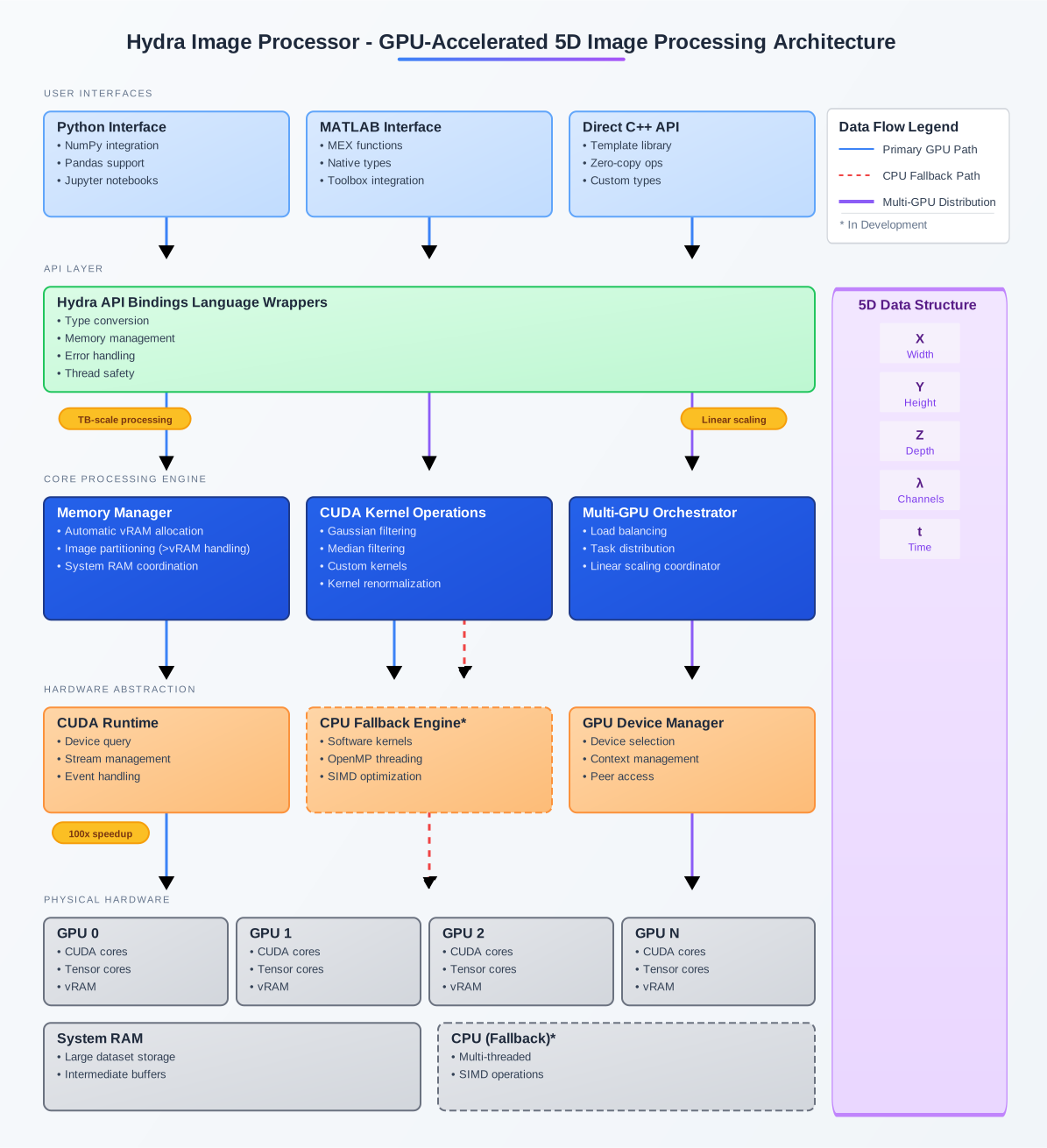 Figure: Hydra’s layered architecture from user interfaces (Python/MATLAB/C++) through the API layer and core processing engine, down to hardware abstraction and physical GPUs. The system handles 5D data structures (X, Y, Z, λ, t) with automatic memory management and linear scaling across multiple GPUs.
The Impact
100x Speedup: Reduced analysis time from days to hours for typical research workflows
Global Adoption: Used by research institutions worldwide for biological imaging analysis
Published in Bioinformatics (2019): Peer-reviewed validation of the approach and performance gains
Open Source: Freely available to the research community, enabling reproducible science
Production Deployments: Powers analysis pipelines at elite research institutions and collaborating laboratories worldwide
Visualization Integration: Works seamlessly with Direct 5D Viewer for interactive visualization of processed data
Technical Stack
Core: C++, CUDA, DirectX APIs: Python (NumPy integration), MATLAB Algorithms: Segmentation, tracking, feature extraction, deconvolution Data Formats: Multi-dimensional biological imaging formats (TIFF, HDF5) Build System: CMake, vcpkg for dependencies
Recognition
- Bioinformatics Publication (2019): “Hydra Image Processor: 5-D GPU image analysis library with MATLAB/Python wrappers”
- Cited in Research: Used in multiple Nature and Nature Communications publications
- Open Source Community: Active GitHub repository with contributions from researchers globally
Links
- GitHub: github.com/ericwait/hydra-image-processor
- Publication: Bioinformatics 2019
- Documentation: Available in repository
- Related Projects: Direct 5D Viewer for interactive visualization, Janelia Research Campus for deployment context
Lessons Learned
Building Hydra taught me the importance of accessible interfaces over raw performance. While achieving 100x speedups was technically impressive, the real impact came from Python/MATLAB wrappers that let researchers use GPU acceleration without learning CUDA. The best optimization is one that people actually use.
This project also reinforced my belief in physics-informed design - understanding the structure of biological imaging data (sparse signals, temporal coherence, spatial locality) allowed targeted optimizations that generic image processing libraries couldn’t match.
How This Connects
Problem-Solving Approach: See how outcome-driven discipline applies across domains → Janelia methodology
Human-Centered Design: Hydra’s accessible interfaces reflect the same philosophy as visual perception-based tools → Direct 5D Viewer
Building What Lasts: Explore sustainable development practices and early organization → MATLAB Utilities
Technical Philosophy: Read more about physics-informed ML and domain knowledge → Home page
Real-World Deployment: See Hydra used in production research → Janelia Research Campus
Full Background: Learn about my journey from photography to computational science → About